
Why Policy Briefs Don’t Change Anything (And How to Fix Them)
- Apr 3
- 2 min read
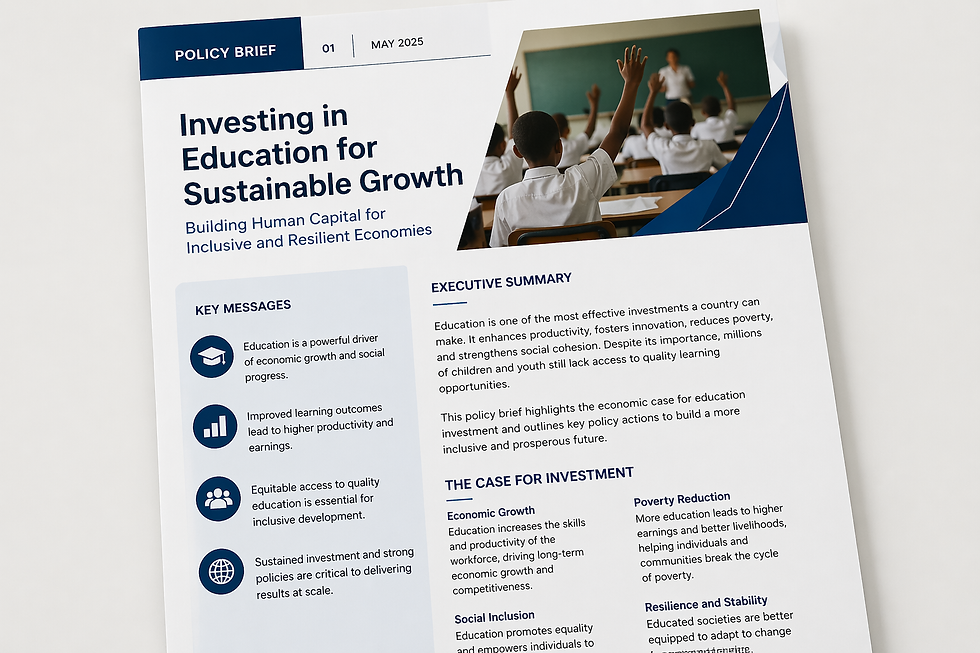
Policy briefs are everywhere. They are written, reviewed, formatted, and shared with stakeholders.They are discussed in meetings, presented in workshops, and submitted to decision-makers. And yet — very few of them actually lead to change. This is not because policy briefs are unnecessary. It is because most of them are designed for reading, not for action.
The Illusion of Influence
A well-written policy brief creates the impression of progress.
It signals:
analysis has been done
recommendations have been made
solutions have been identified
But in practice, many policy briefs:
do not influence decisions
do not shape budgets
do not change implementation
They exist in documents — not in systems.
Where Policy Briefs Fail
From experience across development and government settings, the failure is consistent.
Policy briefs often break down in three key areas:
1. Too Theoretical, Not Practical
Many briefs explain problems well.
They describe:
context
challenges
high-level recommendations
But they fail to answer:
What exactly should be done — by whom, when, and how?
Without operational clarity, decision-makers cannot act.
2. No Link to Resources
Recommendations are made without considering:
budgets
staffing
institutional capacity
A policy that cannot be funded or implemented is not a solution.
It is a suggestion.
3. No Ownership
Policy briefs often do not define:
who is responsible for implementation
who is accountable for results
Without ownership, even strong ideas remain inactive.
What Decision-Makers Actually Need
Decision-makers do not need more documents.
They need:
clear options
realistic actions
defined responsibilities
visible trade-offs
A useful policy brief should function as a decision tool, not just a summary.
What a Strong Policy Brief Looks Like
To be effective, a policy brief must go beyond analysis.
It should clearly define:
1. The Decision
What exactly needs to be decided?
Not just the problem — the choice.
2. The Options
Provide 2–3 realistic options, each with:
cost implications
benefits
risks
3. The Recommended Action
State clearly:
What should be done now?
Avoid vague language.
4. The Implementation Path
Explain:
who will do it
how it will be done
what timeline is realistic
5. The Expected Result
Define what success looks like:
what will change
how it will be measured
A Shift in Thinking
Policy briefs must move from:
Analysis → Recommendation
to:
Decision → Action → Result
This shift is what turns policy into practice.
A Simple Test
Ask:
“If this brief is accepted today, what happens tomorrow?”
If the answer is unclear, the brief is not actionable.
The Bottom Line
The problem is not that policy briefs are ignored. The problem is that many of them are not usable. Decision-makers do not need more insight. They need clear, practical pathways to act.
Final Thought
The value of a policy brief is not in how well it explains a problem. It is in how effectively it enables a decision — and what happens after that decision is made.
If your organization or government team is looking to strengthen how policy translates into real decisions and measurable impact, feel free to get in touch.
Comments